
The goal of sharing our pricing evolution was to show how understanding key concepts such as value and positioning can impact the success of your creative business. When we started out we did not fully understand what our work was worth and how that should effect our price. We did not position ourselves well in the market and that led to us attracting the wrong clients. Relatable right?
The thing is, we learned from our mistakes pretty quickly; we implemented the changes we realised were necessary, and within months saw a change. The first two years of business were a nightmare. We had too many projects at a time and could barely find time to remember to eat. Work life balance, who is she? We made good money despite our low prices, but it was at the cost of our mental and physical health. We revised our business strategy in a way that allowed us to make really good money and still have a life without being overworked. Isn’t that the goal of self-employment?
Learning these things inspired us to create a course called Creative Business Essentials which features what we believe to be the key things that anyone running a creative business needs to grasp to find success. The course was never about making money, it was about sharing our knowledge (WHICH WE ALREADY DO FOR FREE), in a structured way with more detail and interactive elements.
I posted about our pricing evolution in context with also sharing what the course includes and how it can be valuable to people trying to do what we do or those that want to start. People were SO PRESSED and I think it was mainly because they got the “ick” from me promoting our course in what they believed to be a misleading way.
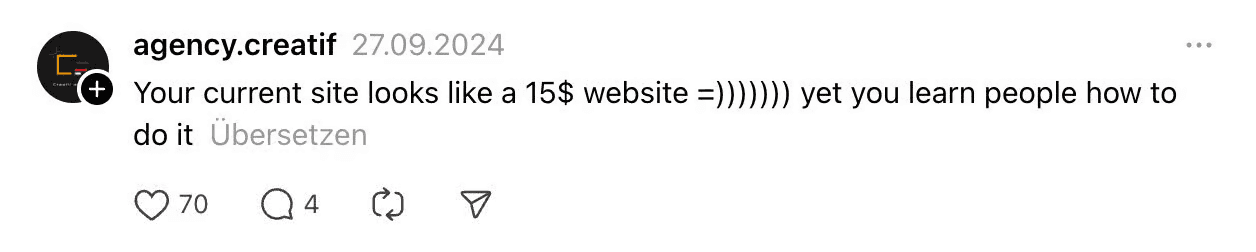
What is funny about the backlash is that most of it was driven by them not thinking we were “good enough” to make the money we said we made based on two things:
Our website is ugly
We made a business course
I want to focus on these two things in this post and reflect on why people jumped to these two conclusions and how that equaled –> we are lying and scamming people.
You don’t need to be the best at something to make good money.
A lot of the comments were about OUR WEBSITE which is hilarious, because no one paid us for that one. Commenters were not happy with the fact that we said we made $150k on a single web design project. They didn’t think our design skills matched the price. They only see value in the aesthetics of a finished product, with zero insight into the context and requirements of the deliverables.
There is a lot of noise online about aesthetics within the design community. It always comes up when a brand does a redesign and people preferred the old design, or think the new one is ugly. Very often designers post their self-proclaimed “better” versions of the redesign. Even funnier is when people start hating on the price of the redesign (because it looks so bad or basic), and how they could have done the same for less money. Um… boasting about low prices is not the flex you think it is.
The thing is the bigger the client and the bigger the budget, the less aesthetics matter. It is almost never about aesthetics when it comes to these budgets. They care about things like:
Tech requirements
Business requirements
Brand goals
They don’t care if people online are going to be judging the outcome or redesigning what they spent hundreds of thousands or in some cases millions on. They don’t care if people (who have no understanding of the requirements by the way) deem it “worthy” of the price or “good enough” or “beautiful” or “better”.
We have been involved in several large scale redesigns for corporate brands in the past two years and the design process has never been about “I prefer this color”, or “this doesn’t look like I was expecting it to”, or “can I see a new design? I don’t like this one”.
Instead the feedback is “is the placement of this clear to the user?”, “does this make sense for our content strategy”, “will this be dynamic and will we be able to change this ourselves?”.
Design rounds are pretty quick with these clients because the decision making is not based on subjective opinions (aesthetics), instead it is driven by strategic ones (data and experience). Despite it sometimes taking less time than with a lower budget client, the value of this work is much higher, and of course also costs more. The client expects you to have the necessary knowledge and strategic thinking skills to create something they trust will be a success. They want to feel as safe as possible in a high risk environment. That comes with a high price tag.
Anyone who calls themselves a designer can create something beautiful for a client that meets their aesthetic requirements. Not every designer can create a product that is driven by strategy that meets a client’s business requirements.
Aside from people questioning our design ability the most common critique we got was that it is impossible to make a lot of money AND sell a course.
Those who can’t do, teach
Who came up with this idea and why do so many people preach this? Besides it being extremely offensive to teachers (who are so important and valuable to us as a society), it is also logically so silly. Teaching is a skill that has nothing to do with the knowledge that is being taught. The skill also needs to be learned and not everyone who is good at what they can do is also good at passing that information on to someone else.
The saying should really be: not everyone who can do, can teach.
The reason I wanted to pull this quote is that I think the idea of “you must be unsuccessful if you have to resort to teaching your craft” is the reason people were so unwilling to believe our prices.
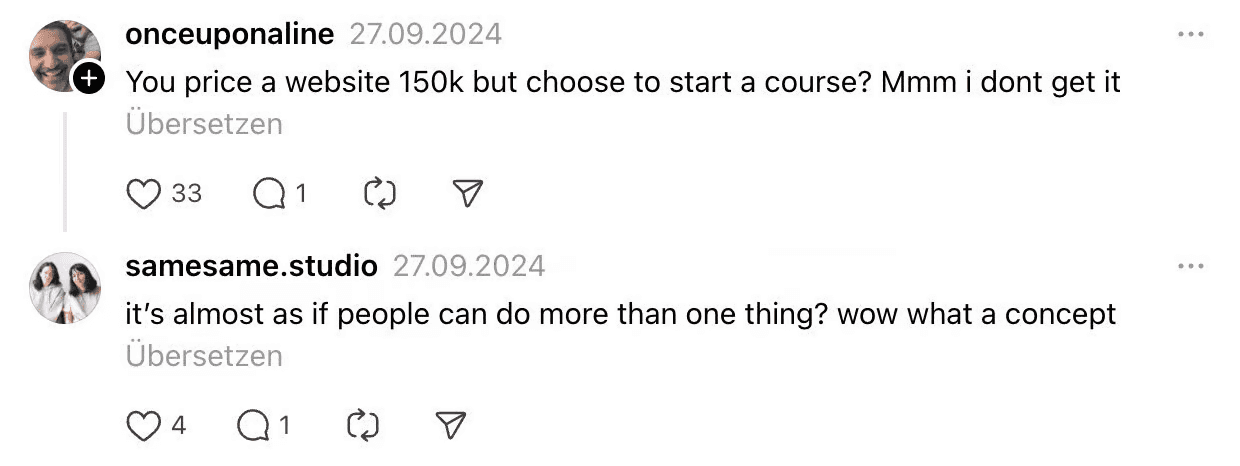
You can be a designer OR someone who makes a course but you can’t do both! And if you are making a course you can’t ALSO be making good money. If you are making $150k on a project, why would you NEED to make a course??? Conclusion: you aren’t really making this money otherwise you wouldn’t need to sell a course and therefore you are lying and you are a scam.
Why we made the course
It should come as no surprise that people enjoy more than one thing. I loooove writing for example (literally why I’m here). I also enjoy being a designer. I also enjoy managing the business, and I also enjoy TEACHING. Whaaat, how can I do all that? And why would I, if I don’t need to?
Our main motivation was to consolidate information we were already giving out for free in a structured, educational format. It is not a new concept. It is also not a new concept to be paid for your work so shocker the course I spent 9 months developing isn’t free.
I would be lying if I said we were not motivated by money at all. It is financially smart to diversify your income. Yes we have big budget clients NOW and that money can sustain us NOW, but what if we ever decide to take a break? What if one of us can’t work and we have less income? What if we have another year like 2023 with almost no leads?
We have been creating educational content for a while now, first on Instagram then with the Podcast, and most recently here on Substack. It seemed like a natural evolution of that pillar of Same Same to create a course.
We started with the business course because we were literally itching to get that content out there. We have been sitting on this knowledge for years and wanted to share it. We aren’t stopping here though. It is the first of many courses to come.
Same Same Studio started as a design and development agency, but we have always been exploring ways to provide value and transparency to our audience that goes beyond your typical agency. I have always loved creating content, and being able to create content that someone who is struggling might find helpful is very rewarding.
Creative Business Essentials is the first course from us, but it definitely won’t be the last, because why not?
And it is not because we need the money, it is because we enjoy doing it and yes two things can be true. We can have success as an agency and still want to explore other income opportunities.
Clients don’t care about how many followers you have on social media
Clout does matter, just not social media clout. Potential clients are often highly influenced by referrals within their network. We are not a nobody in our client network, which is a big reason why we have been able to close high budget contracts.
